knowmyhow.com, powered by Agajod Ltd
Little - Sanctuary of Threads | Wearable History from Victorian Era | Irish Tape Lace Christening Gown | $8,888 USD
Little - Sanctuary of Threads | Wearable History from Victorian Era | Irish Tape Lace Christening Gown | $8,888 USD
Couldn't load pickup availability
Share
Are you one, who is on the fore front of new frontiers? Can you imagine, the incredible bravery, the skills the ability, to cross waters, to seek new life, to have a baby to bring this child to full life...Do you want to dedicate your child, to an incredible legacy of life love and learning itself...
"Sanctuary of Threads — a christening gown from the late 1800s, woven with prayers and permanence. This piece so unique, so breathtaking, such a story, it holds the weight of legacy in every stitch."
Little - A Rare Survivor of Late Victorian Christening Gown Artistry
This is not just textile work. This is heritage craftsmanship.
At 56cm long, 'Little' is a rare survivor of late Victorian christening gown artistry, likely handmade with Irish crochet or tape lace - both prized in the 1800s for ceremonial garments. But this gown is different from its siblings. Stronger. More architectural. More permanent.
This gown was made to last. Made for multiple generations. Made with the weight of legacy in every stitch.
What Makes This Gown Distinct - Expert Analysis
Unlike the other three christening gowns in this collection, 'Little' has characteristics that set it apart:
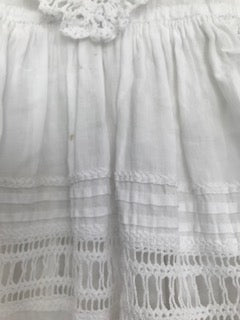
- Stronger threadwork: The motifs and mesh are denser and more sculptural than typical christening lace, suggesting either a regional variation or a maker with exceptional skill
- Vertical and horizontal anchoring: This sleeve has a grid-like strength, possibly incorporating tape lace - where pre-made tapes are shaped and joined with needle fillings, a technique used to reinforce delicate garments
- Scalloped edge and motif repetition: Hallmarks of Irish crochet, but with an architectural quality - almost like 'church window lace' which was sometimes used in ecclesiastical or high-society baby garments
- Made to endure: The construction suggests this wasn't made for one baby, but for generations - preserved with intention, built for permanence
Three Possible Techniques - All Rare, All Valuable
The lace on 'Little' may incorporate one or more of these prized Victorian techniques:
1. Irish Crochet
Characterized by raised motifs connected by delicate mesh, Irish crochet was labor-intensive and highly valued. The lake-like fluidity, scalloped edges, and dimensional quality all point to Irish crochet mastery.
2. Tape Lace
Pre-made tapes are shaped into patterns and joined with needle-made fillings. This creates the grid-like strength visible in the sleeves - reinforcing the gown for durability across generations. Tape lace was used when permanence mattered.
3. 'Church Window Lace'
The architectural, almost geometric quality of the patterns suggests ecclesiastical influence. Church window lace was used in high-society or spiritually significant garments, reflecting a desire for divine protection and sacred beauty.
Emotional and Historical Resonance
This gown may have been:
- Commissioned for a prominent family - the strength and intricacy suggest it wasn't mass-produced
- Preserved with intention - unlike the others, this one feels like it was made to last, perhaps for multiple generations
- Symbolic of protection - in Victorian times, christening gowns were often imbued with spiritual significance, and stronger lace could reflect a desire for divine safeguarding
- Made by Irish hands - possibly a servant, possibly a woman married, bringing skills from Ireland after famine
The Irish Connection - From Famine to Faith
The techniques visible in 'Little' point to Irish craftsmanship - and Irish courage.
Whether made by a servant who traveled with a family, or a woman married making this gown for her own child, she came from Ireland. She had survived the famine - or its long shadow. She knew potatoes as her staple, her survival, her life.
And then she came to New Zealand. Where there was kumara instead of potatoes. Where everything familiar was gone. Where the land was abundant with trees but offered very little food that she knew.
The author of this collection remembers her own grandfather - reaching Lyttelton Harbour from Ireland as a boy, climbing the mountain pass in the snow with his young brothers. Hardy and strong, they made it from one island to another.
This woman - the one who created this tape lace, this Irish crochet, this church window beauty - could have been someone like them. Hardy. Strong. Carrying her skills as her only wealth. Bringing the techniques of home to a land that had none of the structures, none of the certainty she had known.
But she made this gown stronger than the others. She reinforced it with tape lace. She gave it architectural permanence. She wove prayers into every stitch and built it to last for generations.
Days in the Sunlight, Stitching for Eternity
Can you imagine her - sitting in the New Zealand sunlight, working this intricate lace, not knowing if her baby would live long enough to wear it, but making it strong enough to last forever anyway?
Days spent creating the tape lace reinforcements, the Irish crochet motifs, the church window patterns. Fingers working thread in techniques learned in Ireland, now practiced in a land so different, so challenging, so utterly unlike home.
Not knowing if the unfamiliar food would be enough. Not knowing if this tiny infant would survive. But making it permanent anyway, because faith demanded it. Because hope required it. Because this gown would outlast uncertainty.
She said with every stitch: This baby will be blessed in lace that lasts. This gown will protect. This beauty will endure. Even here, even in uncertainty, I build for generations.
Unlike Its Siblings - The Weight of Legacy
This gown is part of a collection of four christening gowns, yet it is profoundly different from the others.
The other three show different techniques - loom lace, extensive eyelet embroidery, hand-made filet lace. Beautiful, yes. But 'Little' is stronger. More architectural. More permanent.
The other gowns were made for beauty. 'Little' was made for legacy.
This suggests:
- A different maker - possibly with higher skill or different training
- A different purpose - made to last for multiple generations, not just one baby
- A different social context - possibly commissioned for a prominent family, or made by someone who understood the weight of permanence
- Spiritual significance - the church window quality, the reinforced construction, the desire for divine protection
Families rarely preserve servants' pieces. Yet here is 'Little' - traveling in the same collection, arriving at the same time, treasured enough to survive over a century alongside the family's gowns.
Her name is lost. But her extraordinary skill - and her determination to build something that would last - remains.
The Land They Found
New Zealand in the 1880s-1910s was a land of contrasts and challenges. Abundant trees but unfamiliar food. No infrastructure. No roads. Everything had to be built from nothing.
For Irish immigrants - especially those who had survived famine - this was both promise and peril. A new land, yes. But one where survival required learning everything anew. Where potatoes became kumara. Where the familiar was replaced by the strange.
And yet they brought permanence. They brought tape lace and Irish crochet and the determination to create gowns that would outlast uncertainty. They built for generations they might never see.
The Smallest, Possibly the Oldest, Built for Eternity
At 56cm, 'Little' was made for a tiny infant - but built to last forever.
This appears to be the oldest piece in the collection of four christening gowns. The size, the tape lace reinforcement, the Irish crochet technique, the church window architectural quality all suggest this gown may predate the others.
Perhaps it was the first - the gown made for the first baby, the one that would be passed down through generations, the treasure that said 'we will build permanence here, we will create legacy that lasts.'
Infant-sized christening gowns this small are exceptionally rare. Most gowns were made larger to accommodate babies of various ages. A gown this tiny, made this strong, was created for a specific purpose - to endure. To protect. To carry prayers and permanence through time.
Beautiful Cloth, Extraordinary Work
The fabric itself is remarkable - fine, soft, beautifully preserved after over a century.
The lace work appears on:
- The sleeves - intricate patterns with grid-like strength, possibly tape lace reinforcement, scalloped edges, church window architectural quality
- The hem - delicate yet durable, Irish crochet motifs connected by mesh, made to last
- Throughout the construction - every stitch done by hand with the precision that tape lace and Irish crochet demand, reinforced for permanence
The workmanship is astonishing. You can see the skill, the patience, the determination to create something that would outlast uncertainty, outlast hardship, outlast even the maker herself.
Condition: Honest and Transparent
Excellent condition for age with three minor age spots (approximately 2mm each) at back - typical and expected for textiles over 100 years old. These small marks are evidence of authenticity, proof that this gown has survived over a century and fulfilled its purpose - it lasted. Otherwise remarkably well-preserved with tape lace and Irish crochet intact, stitching secure, fabric strong.
The presence of minor age-appropriate spotting actually increases collector confidence - it proves this is a genuine antique textile that has endured, just as it was made to do.
A Significant Piece - One of Four, Unlike the Others
This is one of only four christening gowns from the same family collection. The collection includes pieces of varying ages and styles, with the last piece being a small child's hand-made apron.
We found vintage hangers - perhaps 50-odd years old - with children's names written on in pen. Generations of babies wore these sacred gowns, each name a testament to continuity, faith, and family love.
'Little' may have been the first. The gown made to last. The one that carried the weight of legacy. The one woven with prayers and permanence.
A Heritage of Irish Courage and Permanence
This is one of 4 christening gowns from the same family collection, though the specific heritage has been lost to us. What remains is the story of Irish immigrants - hardy and strong - who came to New Zealand after famine, who climbed mountain passes in the snow, who made it from one island to another carrying only their skills and their faith.
The author's own grandfather reached Lyttelton Harbour from Ireland as a boy, climbing the mountain pass with his young brothers. This woman - the one who created this tape lace, this Irish crochet, this church window beauty - could have been someone like them.
Someone who survived. Someone who brought not just beauty, but permanence. Someone whose name is lost but whose determination to build something that would last - something that would carry prayers through generations - immortalizes her.
Provenance & History
- Era: Late Victorian, 1880s-1910s, possibly the oldest piece in the collection
- Length: 56cm (22 inches) - rare infant size, built for permanence
- Style: Infant christening gown with exceptional craftsmanship
- Techniques (expert analysis): Likely Irish crochet and/or tape lace, possibly 'church window lace' - all prized in 1800s for ceremonial garments
- Distinctive characteristics: Stronger threadwork, denser and more sculptural than typical christening lace; grid-like strength suggesting tape lace reinforcement; architectural quality resembling church window lace; scalloped edges and motif repetition
- Why never machine-replicated: Tape lace and Irish crochet are too complex, too dimensional, too reinforced for machine reproduction
- Fabric: Beautiful fine cloth, exceptionally well-preserved after 100+ years
- Condition: Excellent for age - three minor 2mm age spots at back (typical), otherwise remarkably intact - the permanence worked
- Origin: Irish craftsmanship, brought to New Zealand or made in New Zealand by an Irishwoman after famine
- Maker: Possibly a servant, possibly a woman married - Irish immigrant with exceptional skill, possibly trained in ecclesiastical or high-society lace work
- Purpose: Made to last for multiple generations, reinforced for permanence, possibly commissioned for prominent family
- Spiritual significance: Church window lace quality suggests desire for divine protection; Victorian christening gowns were imbued with spiritual meaning; stronger construction reflects safeguarding intention
- Construction: All hand-stitched with precision, possibly incorporating tape lace (pre-made tapes shaped and joined with needle fillings), Irish crochet motifs, architectural reinforcement
- Journey: Part of collection of 4 christening gowns, yet profoundly different - stronger, more permanent, carrying the weight of legacy
- Evidence of use: Vintage hangers with children's names - generations of babies christened, the gown enduring as intended
- Significance: Rare survivor of late Victorian christening gown artistry; possible tape lace and church window lace; Irish immigrant heritage craftsmanship; made for permanence and spiritual protection; possibly servant's work (almost never preserved); represents the determination to build legacy in a new land
The Sacred Significance - Woven With Prayers and Permanence
An Irishwoman - hardy and strong - survived famine and crossed oceans. She brought tape lace skills, Irish crochet mastery, possibly ecclesiastical lace training. She found herself in a land with kumara instead of potatoes, with abundant trees but little familiar food, with no infrastructure and no certainty.
And she sat in the New Zealand sunlight and created this - not just for beauty, but for permanence.
Days spent reinforcing with tape lace. Creating Irish crochet motifs. Building architectural strength into every pattern. Not knowing if her baby would survive. Not knowing if the unfamiliar food would be enough. But making it strong enough to last for generations anyway.
She wove prayers into every stitch. She built permanence into every reinforcement. She created a gown that would outlast uncertainty, outlast hardship, outlast even herself.
She said: This will endure. This will protect. This will carry my prayers through time. Even here, even in uncertainty, I build for eternity.
Her name is lost. We don't know if she was a servant or a woman married. We don't know if this was for her own child or a child in her care. But her skill - her extraordinary tape lace, her Irish crochet, her church window beauty, her determination to build something permanent - survives.
And it tells the story of Irish courage, Irish faith, Irish hands creating not just beauty, but legacy in a new land.
Unlike its siblings, it holds the weight of legacy in every stitch.
Now 'Little' waits for its next custodian - a collector who understands the rarity of tape lace and church window craftsmanship, a museum seeking to preserve Irish immigrant heritage and late Victorian artistry, or a family ready to honor this extraordinary legacy of permanence and protection.
Who This Piece Is For:
- Textile museum curators and archivists (tape lace, Irish crochet, church window lace, late Victorian artistry)
- Irish heritage collectors and institutions
- Ecclesiastical textile specialists
- Serious vintage christening gown collectors
- Lace and needlework scholars (tape lace and Irish crochet specialists)
- Migration and social history museums (Irish immigration to New Zealand, famine survivors)
- Victorian costume and textile historians
- Families of Irish heritage seeking authentic heirloom pieces built for generations
Investment & Value
Rare infant christening gowns with identified tape lace and Irish crochet, especially those with church window architectural quality and spiritual significance, are exceptionally valuable to collectors and institutions. The 56cm size, the reinforced construction for permanence, the possible ecclesiastical influence, the Irish immigrant provenance, and the possible servant's work (almost never preserved) make this piece museum-quality. Late Victorian christening gowns with tape lace and exceptional craftsmanship have sold for $6,000-$10,000+ USD to serious collectors, with immigrant heritage and spiritual significance adding substantial value.
Worldwide Shipping Available
This piece is able to be very carefully shipped worldwide at buyer's advice and choice. We understand the precious nature of these textiles and will work with serious collectors and institutions to ensure safe, appropriate packaging and shipping methods. International buyers welcome - let us know your location and requirements.
Viewing & Authentication
Serious inquiries welcome. Additional detailed photographs available upon request. We encourage professional textile authentication for pieces of this caliber. Tape lace and Irish crochet specialists will recognize the techniques immediately. Church window lace experts and Victorian textile scholars welcome.
'Little' - Sanctuary of Threads. A rare survivor of late Victorian christening gown artistry. Tape lace and Irish crochet. Church window beauty. Woven with prayers and permanence. Made to last for generations. Hardy Irish hands creating legacy in a new land. Unlike its siblings, it holds the weight of legacy in every stitch. Will you be its next keeper?
From The Convent Story Collection - Pieces of contemplation, sacred moments, and handwork that honors the divine.